The Tiny Factory Workers: Understanding Enzymes
Imagine your body is a giant factory. Every second, millions of jobs need to be completed digesting food, building cells, repairing tissues, and releasing energy. Without helpers, these jobs would happen far too slowly. These helpers are called enzymes.
What Are Enzymes?
Enzymes are proteins that act as biological catalysts. A catalyst speeds up a chemical reaction without being used up in the process.
Meet the Lock and Key Team
Think of an enzyme as a lock and the substance it works on (the substrate) as a key. Only the correct key fits the lock. In the same way, each enzyme only works with a specific substrate.
When the substrate fits into the enzyme’s active site, an enzyme-substrate complex is formed. The reaction takes place, products are released, and the enzyme is ready to work again.

Why Are Enzymes Important?
Digest food into smaller molecules
Help cells release energy during respiration
Build important substances in the body
Speed up thousands of reactions needed for life
Factors Affecting Enzymes
Temperature
As temperature increases, enzymes and substrates move faster, increasing reaction rate. However, if the temperature becomes too high, the enzyme changes shape and becomes denatured. A denatured enzyme can no longer work properly. The optimum temperature is the temperature at which the enzyme works at its maximum rate before denaturation begins.

pH
Every enzyme has an optimum pH. If the pH becomes too acidic or too alkaline, the active site may change shape, and the enzyme may stop working. The optimum pH is the pH at which the enzyme's active site has the ideal shape for maximum activity.

Substrate Concentration
Increasing substrate concentration usually increases the reaction rate because more enzyme active sites are occupied. Eventually all active sites become busy and the rate levels off. The optimum substrate concentration is the concentration at which all enzyme active sites are occupied, causing the reaction rate to reach its maximum and level off.

Enzyme Concentration
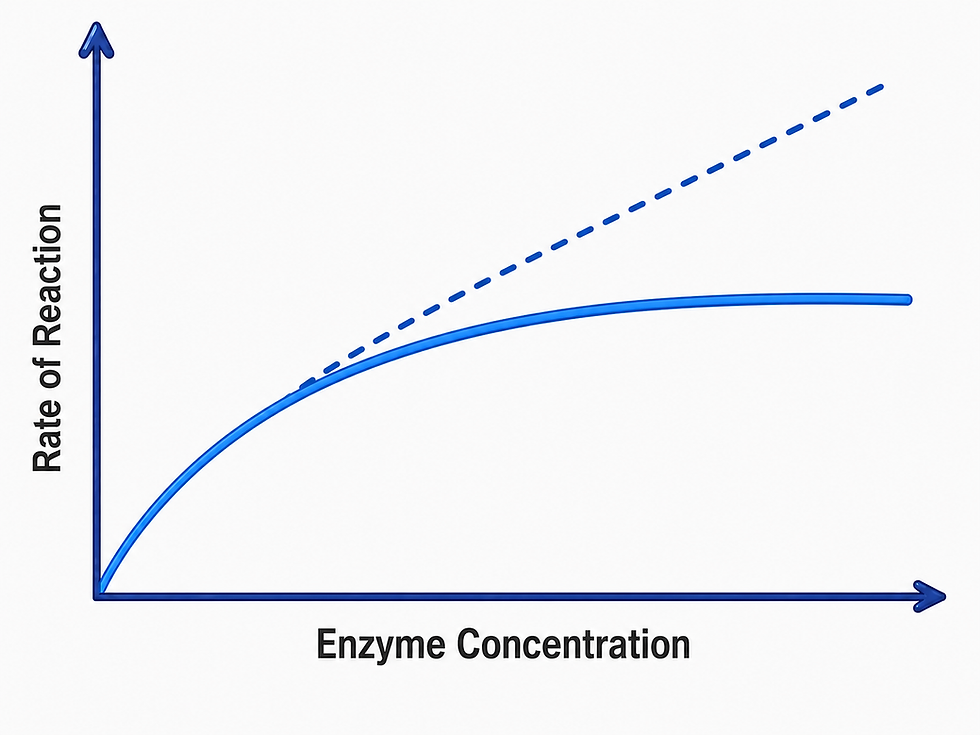
Increasing enzyme concentration usually increases the reaction rate because more active sites are available for substrates to bind. However, once the substrate becomes the limiting factor, adding more enzymes will no longer increase the reaction rate. The optimum enzyme concentration is the concentration at which the reaction proceeds at its maximum rate for the available amount of substrate.
Real Life Examples
Amylase breaks down starch into simpler sugars.
Protease breaks down proteins into amino acids.
Lipase breaks down fats into fatty acids and glycerol.
Quick Summary
Enzymes are biological catalysts.
They are proteins.
Each enzyme is specific to its substrate.
Temperature, pH and substrate concentration affect enzyme activity.
Enzymes are essential for life.

