Photosynthesis [The Solar-Powered Sugar Factory]
What is Photosynthesis?
Imagine a leaf is like a tiny, green factory. Inside the factory, the plant uses sunshine, water, and air to
make its own yummy food called glucose (sugar). This entire process is called Photosynthesis.
The Two-Stage Assembly Line
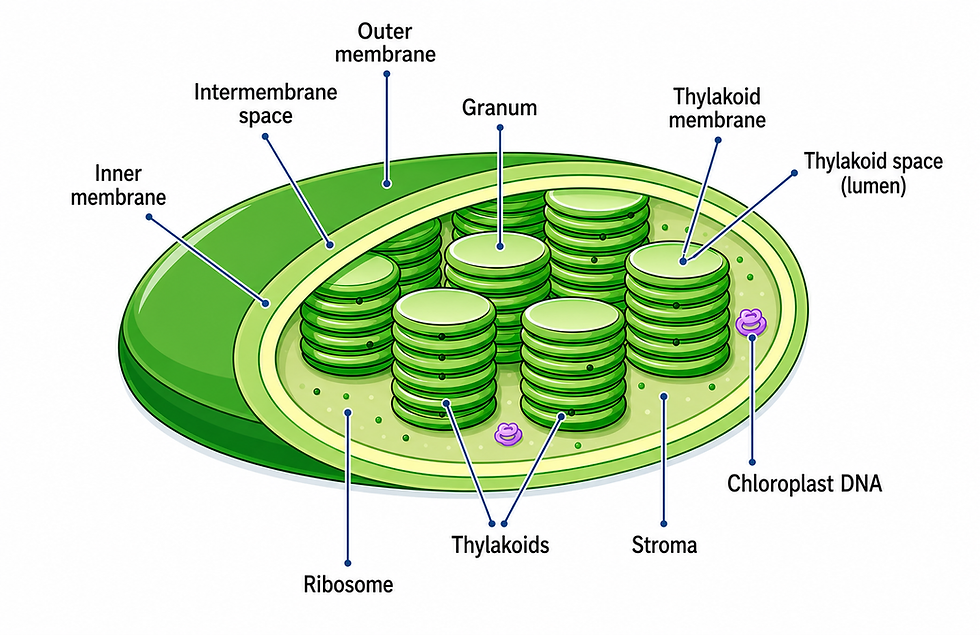
Photosynthesis isn't just one step; it's a two-part team effort happening inside tiny structures called chloroplasts.
Light-Dependent Reaction: The "Charging Stage" (Uses light to make energy).
Calvin Cycle (Light-Independent): The "Sugar-Making Stage" (Uses that energy to build food).
Stage 1: The Light-Dependent Reaction (Charging Up!)

Location: Inside the thylakoid membranes (the tiny green discs).
Catching Light: Sunlight hits the green chlorophyll (in Photosystem II) and makes tiny particles called electrons very excited.
Replacing Electrons: The plant splits a water molecule (H₂O) into hydrogen, electrons, and oxygen (Photolysis).
The Oxygen Bonus: The oxygen is released into the air-the oxygen we breathe!
Moving Energy: Electrons travel along an "electron transport chain," pumping hydrogen ions (H+) into the thylakoid lumen.
Making Batteries: H+ ions flow through ATP synthase, creating energy-rich ATP.
Final Charge: Electrons reach Photosystem I, becoming excited again to turn NADP into NADPH.
Stage 2: The Calvin Cycle (Building the Sugar)

Location: The stroma (the jelly-like filling of the chloroplast).
Carbon Fixation: Carbon Dioxide (CO2) joins a 5-carbon molecule called RuBP using the enzyme
RuBisCO.
Creating Building Blocks: This forms an unstable molecule that splits into 3-PGA (also known as GP).
Using the Batteries: Using energy from ATP and NADPH, the plant converts 3-PGA into G3P.
Success!
Some G3P leaves to become Glucose.
The Cycle Continues: The rest of the G3P is recycled back into RuBP so the factory can keep working!
Key Terms To Remember
Chloroplast
The green "factory" inside the plant cell.
Photolysis
Splitting water using light to get electrons.
ATP/NADPH
The "batteries" that store energy.
RuBisCO
The "chef" enzyme that grabs CO2.
G3P
Building block molecule for Glucose.
Examiner's Tip
Think of this like a kitchen. The Light-Dependent reaction is the "power," and the Calvin Cycle is the
"chef" using that power to bake a glucose cake!

